

Introduction: Wisdom on Four Paws
The Vedas speak of the oneness of all life. The Dhammapada teaches mindfulness. The Upanishads reveal the nature of the Self. Cassie? She has never read a single word of them. Yet every day, she lives them—naturally, effortlessly, as if these eternal truths were woven into her very being.
This is not a coincidence. It is a lesson.
Animals do not follow scriptures. They are scriptures in motion. Their existence is a silent commentary on the teachings that we humans must study, meditate upon, and practice. Cassie does not replace the sacred texts; she illuminates them with a purity that our cluttered minds sometimes struggle to achieve.
Here is how, through her simple actions, she has helped me understand—and embody—the deepest dogmas of Hinduism and Buddhism.
I. Hindu Lessons: Cassie and the Eternal Texts
1. The Vedas: The Ritual of the Everyday
The Vedas are the oldest texts of Hinduism, revealed to the rishis (sages) in meditation. They celebrate the forces of nature as divine manifestations. Cassie, without knowing it, is a perfect practitioner.
-
Agni, the sacred fire: In the Rig-Veda, Agni is the god of fire, the messenger between humans and gods. When Cassie curls up near the heater or basks in a sunbeam, she honors this same life energy. She does not chant mantras, but her body becomes an offering to warmth—a spontaneous puja (worship). Lesson: The sacred is not confined to temples. It is in the moment we welcome light, when we warm ourselves—physically and spiritually.
-
Karma Yoga (selfless action): The Bhagavad-Gîtâ (3.8) teaches: "Perform your duty without attachment to the results." Cassie chases a fly, lets it escape, and moves on. She acts neither out of pride nor frustration. She simply acts. Lesson: Detachment is not renunciation; it is acting with full attention, then letting go.
-
Dharma (sacred duty): Every being has its dharma. Hers? To be a cat: to observe, play, rest, and love. She does not wonder if she is "succeeding" at life. She simply lives it. Lesson: Our dharma is not a performance; it is a presence.
2. The Upanishads: Knowledge Through Being
The Upanishads explore the nature of the âtman (the Self) and Brahman (the Ultimate Reality). Cassie offers a silent demonstration.
-
"Tat Tvam Asi" ("Thou art That," Chandogya Upanishad): When she snuggles against me, our breaths synchronize. For a moment, the boundary between "me" and "her" fades. Unknowingly, she teaches advaita (non-duality): we are not separate. Lesson: Unity is not a philosophical idea. It is an experience to be lived—in a glance, a touch, a shared silence.
-
Natural meditation: The Upanishads describe meditation as a state of pure consciousness. Cassie, motionless before a window, watches birds with absolute focus. She needs no techniques. She is meditation. Lesson: Mindfulness is not reserved for yogis. It is available in every moment, in pure observation.
-
Moksha (liberation): She does not fear death. She does not cling to life. She lives each day as if it were both eternal and fleeting. Lesson: Liberation is not a distant goal. It is in the serene acceptance of the present moment.
3. The Bhagavad-Gîtâ: Action and Surrender
Krishna teaches Arjuna the art of acting with devotion, without attachment to outcomes. Cassie is a model student.
-
"Perform your duty without desire for reward" (BG 2.47): She meows for food, eats, and then sleeps without overthinking. No calculations, no regrets. Lesson: Right action arises from the needs of the moment, without projection into the future.
-
Equanimity (samatvam): Whether it rains or shines, whether she is alone or surrounded, she remains herself. As Krishna says (BG 2.48): "The wise are unshaken in success or failure." Lesson: Inner peace does not depend on circumstances.
-
Unconditional love (bhakti): She does not love me because I am "good" or "perfect." She loves me because I exist. This is the purest bhakti: love without conditions or expectations. Lesson: True love does not judge. It recognizes.
4. Tantra: The Body as Temple
Tantric texts (like the Vijnana Bhairava Tantra) view the body as a tool for spiritual realization. Cassie uses hers without hesitation.
-
Breath (pranayama): Her rising and falling belly is a lesson in conscious breathing. She does not control her breath—she listens to it. Lesson: Spirituality begins with the body, here and now.
-
Energy (shakti): When she stretches, arching her back, she naturally activates her kundalini (vital energy). She does not seek to "awaken" anything. She is that energy. Lesson: We do not need to "search" for spirituality. We already are it.
II. Buddhist Lessons: Cassie and the Path of Awakening
1. The Dhammapada: The Law of Nature
This collection of verses summarizes the Buddha’s teachings. Cassie embodies them.
-
"All that we are is the result of what we have thought." (Dhammapada 1.1): She has no complicated thoughts, but her actions are always aligned with her being. She does not lie, cheat, or manipulate. Lesson: Wisdom arises from alignment between mind, speech, and action.
-
Impermanence (anicca): She plays with a ball of yarn, drops it, and moves on. "Sabbe sankhara anicca"—"All conditioned things are impermanent." Lesson: Clinging causes suffering. Letting go brings peace.
-
Compassion (karuṇā): When I am sad, she comes and presses against me. Not out of pity, but out of presence. As the Buddha said: "Compassion is the greatest protection." Lesson: Being there for another—without trying to "fix"—is the greatest gift.
2. The Suttas: Wisdom in Action
-
The Heart Sutra and emptiness (śūnyatā): "Form is emptiness, emptiness is form." Cassie embodies this truth: she has a form (a body, fur, claws), but when she sleeps, she disappears into her rest. No "cat," just space. Lesson: We are not our roles, possessions, or thoughts. We are much vaster.
-
The Four Noble Truths:
- Suffering exists: When she is hungry, she meows. She does not deny it.
- Suffering has a cause: Her hunger is a natural need, not a punishment.
- Suffering can cease: When she eats, she is at peace.
- The path is simple: She does not complicate things. She acts, then lets go. Lesson: The end of suffering begins with acceptance.
-
Mindfulness (sati): When she drinks, she is fully present with her water bowl. When she sleeps, she is fully asleep. Lesson: Happiness lies in complete attention to what is.
3. Zen: Awakening in the Ordinary
Zen masters teach that enlightenment (satori) is accessible in the simplest gestures. Cassie is a furry Zen master.
-
"When you eat, eat. When you walk, walk." (Master Lin Chi): She does one thing at a time. And she does it completely. Lesson: Distraction is a human habit. Presence is our nature.
-
Koans and beginner’s mind: A koan asks: "What is the sound of one hand clapping?" Cassie would answer by licking her paw. The question makes no sense? Perfect. Neither does life, sometimes. Lesson: Wisdom is not in answers, but in openness to the unknown.
-
Zazen ("just sitting"): She can sit for hours, gazing at a wall. Not out of boredom, but because she is the wall, the gaze, and the space between. Lesson: Meditation is not a technique. It is a state of being.
III. Shiva and Buddha: Two Paths, One Dance
1. Shiva: The Cosmic Dancer
Shiva Nataraja dances the cycle of destruction and creation. Cassie does the same:
- Destruction: She tears up toilet paper (and my illusions with it).
- Creation: She brings blades of grass as offerings.
- Stillness: When she freezes before pouncing, she is Shiva in samadhi—the perfect balance between movement and silence. Lesson: Life is a dance. Sometimes, destruction is necessary for creation.
2. Buddha: The Awakened One on Four Paws
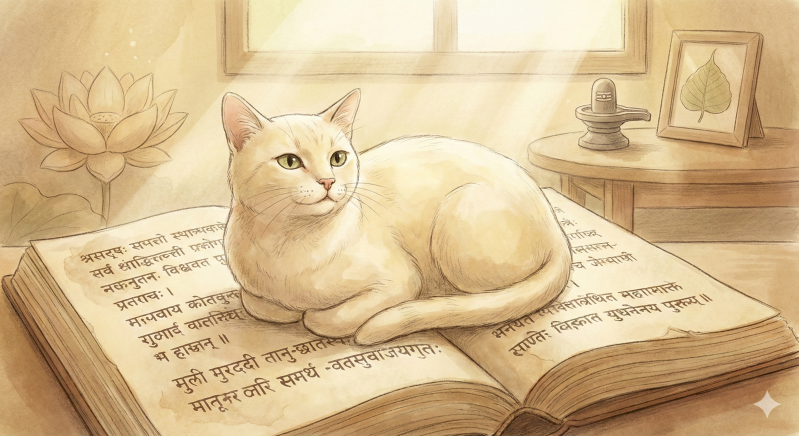
The Buddha attained enlightenment sitting under the Bodhi tree. Cassie sits on my philosophy book and purrs.
- Right posture: She does not force meditation. She is meditation.
- Awakening (bodhi): She does not need to "seek." She is already awake. Lesson: So are we. We have simply forgotten.
IV. The Synthesis: Cassie, Mirror of the Scriptures
Cassie does nothing "special." She is simply herself—and that is the genius.
- She does not follow the texts. She embodies them.
- She does not seek wisdom. She lives it.
- She does not replace the scriptures. She shows us how to apply them.
Concrete Examples:
Text/Teaching Cassie Illustrates It Thus Lesson for Us "Ahimsa" (non-violence) She chases flies but does not kill them. Compassion is a daily choice. "Satya" (truth) She has no masks. If hungry, she meows. Authenticity liberates. "Aparigraha" (non-possession) She plays with a string, then leaves it. Happiness is not in accumulation. "Mettā" (loving-kindness) She purrs even when disturbed. Love is a practice, not just a feeling. "Tapas" (discipline) She wakes early, stretches, "meditates" (staring at a wall). Routine can be sacred.
Epilogue: The Path Is Beneath Our Paws
The sacred texts are maps. Cassie is the territory.
She does not say: "Abandon the scriptures." She whispers: "Live them."
- To students of the texts: Study, but do not forget to live.
- To spiritual seekers: Truth is not only in books. It is in a cat’s purr, the breath of the wind, the silence between thoughts.
- To all: Wisdom is not a destination. It is a way of walking—or sitting, like Cassie, on the open book of life.
Final Image: Tonight, as every night, I will read a verse from the Upanishads. Cassie will come and sit on the book. I will not shoo her away. I will smile. For she reminds me that the greatest study is that of the present moment—and that the best teacher is often the one who says nothing.
"Scriptures are like a lamp in the dark," says an Indian proverb. "But when the sun rises, the lamp is no longer needed." Cassie is that sun. And I? I am still learning to open my eyes.
Ajouter un commentaire
Commentaires