

Introduction: The Breath of Dharma Between the Paws of a Silent Master
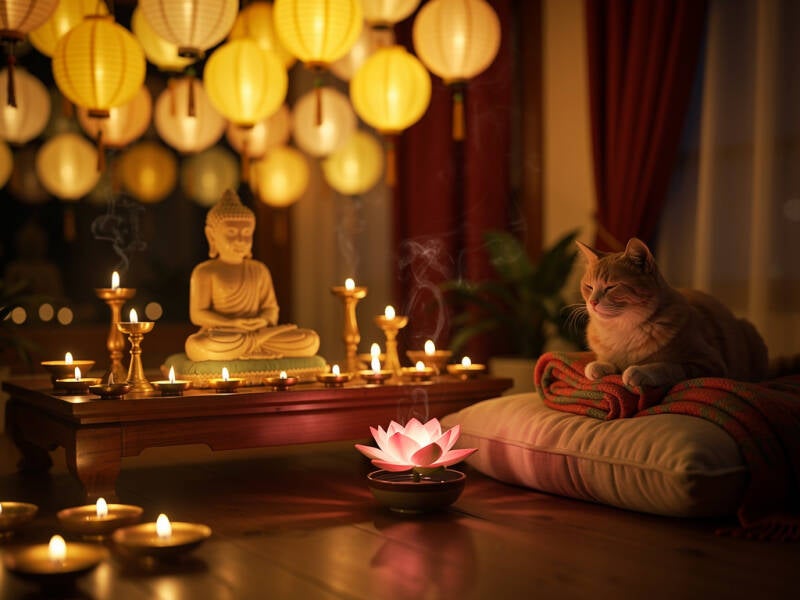
There are mornings when light filters through the curtains like a blessing, drawing golden patterns on the floor. In these moments, as the world seems suspended, a four-legged being stretches with infinite grace. She says nothing, but her simple gesture—the curve of her back, the slowness of her awakening—is a lesson in mindfulness. She doesn't need to read the Dhammapada to embody impermanence, nor recite the Heart Sutra to understand emptiness. She is, and in that being, resides all the wisdom of Buddhism.
Yet we humans cling to words, rituals, explanations. We seek nirvana in texts, when perhaps it is cuddled against our legs, purring. This article is an invitation to see dharma not as a distant doctrine, but as a daily dance, where each step is guided by love, patience, and the curiosity of a being who, unknowingly, teaches us to live. We will explore the teachings of Tibetan Buddhism, Zen, and the traditions of India and Nepal, to see how these different traditions can help us live a more conscious and compassionate life.
Buddhism and Mindfulness: Living in the Present Moment
The Dhammapada and the Art of Being Present
The Dhammapada reminds us: "All that we are is the result of what we have thought." But how to meditate on this truth when the mind is restless as a leaf in the wind? She knows, she who spends hours watching a sunbeam or the flight of a bird. Her attention is total, without judgment, without expectation. She does not think of yesterday, nor of tomorrow. She breathes.
In Tibetan Buddhism, mindfulness is often practiced through attention meditation (shamatha), which aims to calm the mind and develop stable concentration. Zen, on the other hand, emphasizes seated meditation (zazen), which consists of sitting in silence and observing thoughts without attaching to them.
Practical Exercise:
-
Sit near her, close your eyes.
-
Listen to her breathing, slow and steady.
-
Let your thoughts pass like clouds, without clinging to them.
-
When your mind wanders, gently bring it back to that shared breath.
This is vipassana meditation: observing without reacting. She is your first teacher.
Compassion in Action: The Living Mettā Sutta
Unconditional Love as a Daily Practice
The Mettā Sutta teaches us to cultivate boundless loving-kindness: "May all beings be happy." But how to embody this compassion? Watch her when she brings you an "offering"—a leaf, a toy—with pride. She asks for nothing in return. She simply gives.
In Tibetan Buddhism, the practice of compassion is often associated with loving-kindness meditation (metta), which aims to develop a feeling of love and compassion for all beings. In India and Nepal, this practice is often integrated into daily rituals and offerings to deities.
Morning Ritual:
-
While feeding her, mentally say: "May you be happy, safe, at peace."
-
Extend this thought to all beings you will meet during the day.
She shows you that compassion is not a concept, but a gesture.
Impermanence and Letting Go: Shiva and the Dance of Life
Dancing with Change
Shiva, in his cosmic dance, destroys to recreate. She jumps on your lap when you work, then leaves without warning. She does not apologize, does not explain herself. She lives impermanence with a lightness that often escapes us.
In Tibetan Buddhism, impermanence is a central concept, often illustrated by the wheel of life (bhavacakra), which shows how all things are constantly evolving. Zen, for its part, emphasizes the acceptance of impermanence through meditation practice and understanding the ephemeral nature of all things.
Reflection:
-
When something bothers you, ask yourself: "Will this matter in five years?"
-
As she lets go after a wild run, learn to release what weighs on your heart.
Karma as a Lesson, Not as Punishment
Acting Without Attachment to Results
The Bhagavad Gita tells us: "You have the right to work, but never to the fruit of your work." She hunts insects but does not kill them. She plays with them, then lets them go. She acts without attaching to the result.
In Tibetan Buddhism, karma is seen as a natural law of cause and effect, where our past actions influence our present and future. Zen, on the other hand, emphasizes action without attachment to results, focusing on the present moment.
Practice:
-
Today, do an action (cook, write, help) without expecting recognition.
-
Observe how this changes your relationship to effort.
Gratitude: A Daily Mantra
Om Shreem Maha Lakshmiyei Swaha
Lighting a lamp for Lakshmi is to honor abundance. But abundance is also her cuddling against you after a long day, her purring that soothes your insomnia.
In the traditions of India and Nepal, gratitude is often expressed through rituals and offerings to deities. Tibetan Buddhism also emphasizes gratitude through meditation and prayer practices.
Evening Ritual:
-
Note three moments of gratitude (e.g., "Her look when I come home", "Her paw on my arm").
-
Repeat the mantra Om Shreem Maha Lakshmiyei Swaha while thinking of these moments.
Meditation of the Five Senses
A Practice Inspired by the Satipatthāna Sutta
The Satipatthāna Sutta guides us to anchor our attention in the body and senses. She does this naturally:
-
She tastes her food with delight.
-
She touches every surface with curiosity.
-
She listens to the slightest rustle.
In Tibetan Buddhism, meditation on the five senses is often practiced to develop an acute awareness of the environment. Zen also emphasizes mindfulness of the senses through practices such as walking meditation (kinhin).
Exercise:
-
Take an object (a leaf, a stone).
-
Observe it as she would observe prey: with all your senses.
-
This is a mindfulness meditation.
Night and Darkness: Diwali in the Gaze of a Feline
Finding Light in Darkness
Diwali celebrates the victory of light over darkness. She, with her eyes shining in the dark, is a living candle. When you are afraid or doubt, look at her: she moves forward, even in darkness.
In the traditions of India and Nepal, light is often symbolized by lamps and candles, which represent knowledge and wisdom. Tibetan Buddhism also uses symbols of light, such as butter lamps, to represent the clarity of mind.
Visualization:
-
Close your eyes, imagine her eyes as two stars.
-
Let this light dissolve your fears.
Death and Rebirth: The Lotus Sutra in a Purr
Accepting the End for Rebirth
The Lotus Sutra speaks of transformation. She, one day, will no longer be there. But her teaching—love, patience, simple joy—will remain.
In Tibetan Buddhism, death is seen as a transition to a new existence, and the practice of meditation on death (maranasati) is often used to prepare for this transition. Zen emphasizes the acceptance of death as a natural part of life.
Meditation:
-
Sit down, think of a dear departed being.
-
Breathe, and feel how their love still lives in you.
Conclusion: Dharma on Four Paws
Sacred texts are maps, but the journey is made step by step, with those who accompany us. She will never read the sutras, but she lives them. And perhaps this is the most beautiful lesson: Buddhism is not a theory, but a life.
So, the next time she sits on your yoga mat or interrupts your meditation, smile. She reminds you that wisdom is not in books, but in the present moment.
Shanti Om.
Ajouter un commentaire
Commentaires