

Buddhism: Meditation and Ritual — Differences, Complements, and Deep Presence (with Cassie 🐾)
There are days when we look for silence.
And other days when we need a gesture.
A simple breath… or a small inner ceremony.
In Buddhism, meditation and ritual can seem like opposites: one looks “empty,” the other “full.” One feels free, the other structured. Yet when we look at them gently, we understand they are like two doors leading to the same room: presence.
And sometimes… that presence reveals itself in the simplest things.
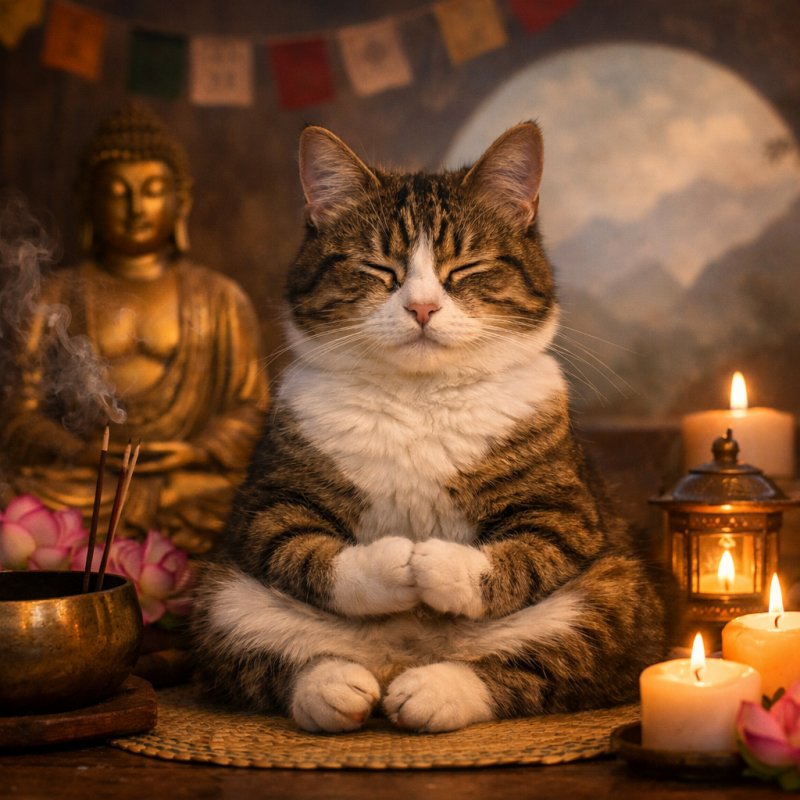
Like when Cassie, my cat, sits near me right when I sit down too. No effort. No theory. Just there.
1) Meditation: Sitting in the present moment
In the Buddhist spirit, to meditate is not “to succeed” at having no thoughts.
It is rather to:
-
see what is here (thoughts, emotions, sensations),
-
not cling to it,
-
come back… again and again.
Meditation teaches us something essential:
You are not what passes through you. You are also the space that sees it.
When I meditate, I don’t create anything.
I don’t try to become someone.
I make myself available.
And sometimes peace appears there: not as a reward, but as an absence of struggle.
What meditation transforms (deeply)
Over time, meditation works like a soft light that illuminates our patterns:
-
impatience,
-
the need to control,
-
fear of lacking,
-
anger trying to protect itself,
-
sadness asking to be acknowledged.
It doesn’t erase all of that.
It makes us more honest.
And in that honesty… something loosens.
2) Ritual: Giving shape to the sacred
A Buddhist ritual is a symbolic practice.
An action that speaks to the heart as much as to the mind.
It can be very simple:
-
lighting a candle,
-
offering incense,
-
reciting a mantra,
-
bowing,
-
setting an intention,
-
making an offering (even an inner one).
Ritual is not there to “impress the universe.”
It is there to align your being.
Because a human being is not only a mind.
We need gestures.
Rhythm.
Beauty.
Repetition.
And in that repetition, something is built:
inner stability.
What ritual supports (in daily life)
Ritual is an anchor.
It can help when:
-
you feel scattered,
-
you are tired,
-
you are going through grief,
-
you need meaning,
-
you want to honor life.
It tells the body:
“Here, this moment matters. Breathe.”
3) Meditation vs ritual: what are the differences?
Here is a simple and clear comparison:
Meditation…
-
seeks bare presence,
-
explores silence,
-
highlights impermanence,
-
trains us to observe without grasping,
-
is often lived in stillness.
Ritual…
-
gives form to presence,
-
uses symbolism,
-
nourishes faith, trust, intention,
-
trains us to embody (through a gesture),
-
is often lived through action.
But be careful:
-
meditation can become a ritual (if we do it mechanically),
-
and ritual can become a meditation (if we live it fully).
Everything depends on the spirit in which we practice.
4) The trap: practicing without presence
This is where Buddhism is very lucid.
We can:
-
meditate to escape our emotions,
-
perform rituals to feel safe,
-
repeat mantras while thinking about something else,
-
search for a spiritual identity instead of searching for truth.
And yet… the path is not a performance.
The path is simplicity.
Honesty.
If you are here, even imperfectly, you are already practicing.
5) When to choose meditation? When to choose ritual?
Choose meditation if…
-
you want to calm a restless mind,
-
you want to learn to welcome your emotions,
-
you want to understand your patterns,
-
you want to return to what matters.
Choose ritual if…
-
you need structure,
-
you want to create a sacred space at home,
-
you are going through a fragile time,
-
you want to honor an intention (healing, gratitude, peace).
And the truth?
You can do both.
Because:
-
meditation strips you down,
-
ritual gathers you back together.
6) Cassie, my cat, and the purest lesson
Cassie doesn’t meditate “to become better.”
She doesn’t perform a ritual “to succeed at her day.”
She settles.
She listens.
She feels.
When she stretches in the sun, she is not somewhere else.
She doesn’t compare herself.
She doesn’t anticipate.
She is.
And that’s when I understand something:
Spirituality is not always an ascent.
Often, it is a return.
A return to what is simple.
A return to what is alive.
7) A short practice (meditation + mini ritual)
If you want a gentle and complete practice, here is a 5-minute suggestion.
Step 1 — mini ritual (1 minute)
-
Place one hand on your heart.
-
Breathe in softly.
-
Say inwardly:
“I am here. And that is enough.”
Step 2 — meditation (3 minutes)
-
Observe your breathing.
-
Don’t control it.
-
Return to the air moving in and out.
Step 3 — offering presence (1 minute)
-
Think of a being (human or animal 🐾) you love.
-
Send them a simple phrase:
“May you be at peace.”
That’s all.
And it’s immense.
Conclusion: two paths, one presence
Meditation and ritual are not opposing teams.
They are tools.
-
One opens space.
-
The other gives it form.
And at the center of everything… there is this moment.
The moment you breathe.
The moment you return.
The moment you stop fighting.
Like Cassie.
Simple.
Present.
Deeply alive.
If this article touched you, you can reread it as a gentle reminder:
The path is not far. It is here.
🐾✨
Ajouter un commentaire
Commentaires