

The Śruti: the Heard Word, the Living Source of Hinduism
In Hinduism, there are texts we read, study, and comment on… and then there is a word even older, vaster, almost impossible to lock inside a page.
This word is called Śruti (श्रुति).
The term means “that which has been heard.”
Not “heard” like a piece of information we receive, but heard like a sacred breath moving through the human being—like a truth that does not come only from the mind… but from a deep inner listening.
The Śruti are often considered the first source of the Hindu tradition: they are not seen as texts “invented” by humans, but as a revelation perceived by sages.
1) Śruti: knowledge that is received, not manufactured
In many traditions, people speak of holy books. In Hinduism, the Śruti are more than books: they are an experience.
It is said that the sages, called ṛṣi (ऋṣi), “heard” this wisdom in a very high state of consciousness. As if the universe itself was speaking, and certain beings, in their silence, knew how to listen.
This gives the Śruti a unique presence:
-
they are not only texts to memorize,
-
they are a vibration to transmit,
-
a light that reveals itself to the one who approaches with respect.
The Śruti remind us of something essential:
Wisdom is not always something you chase…
sometimes, it is something that finds you.
2) Which texts are Śruti?
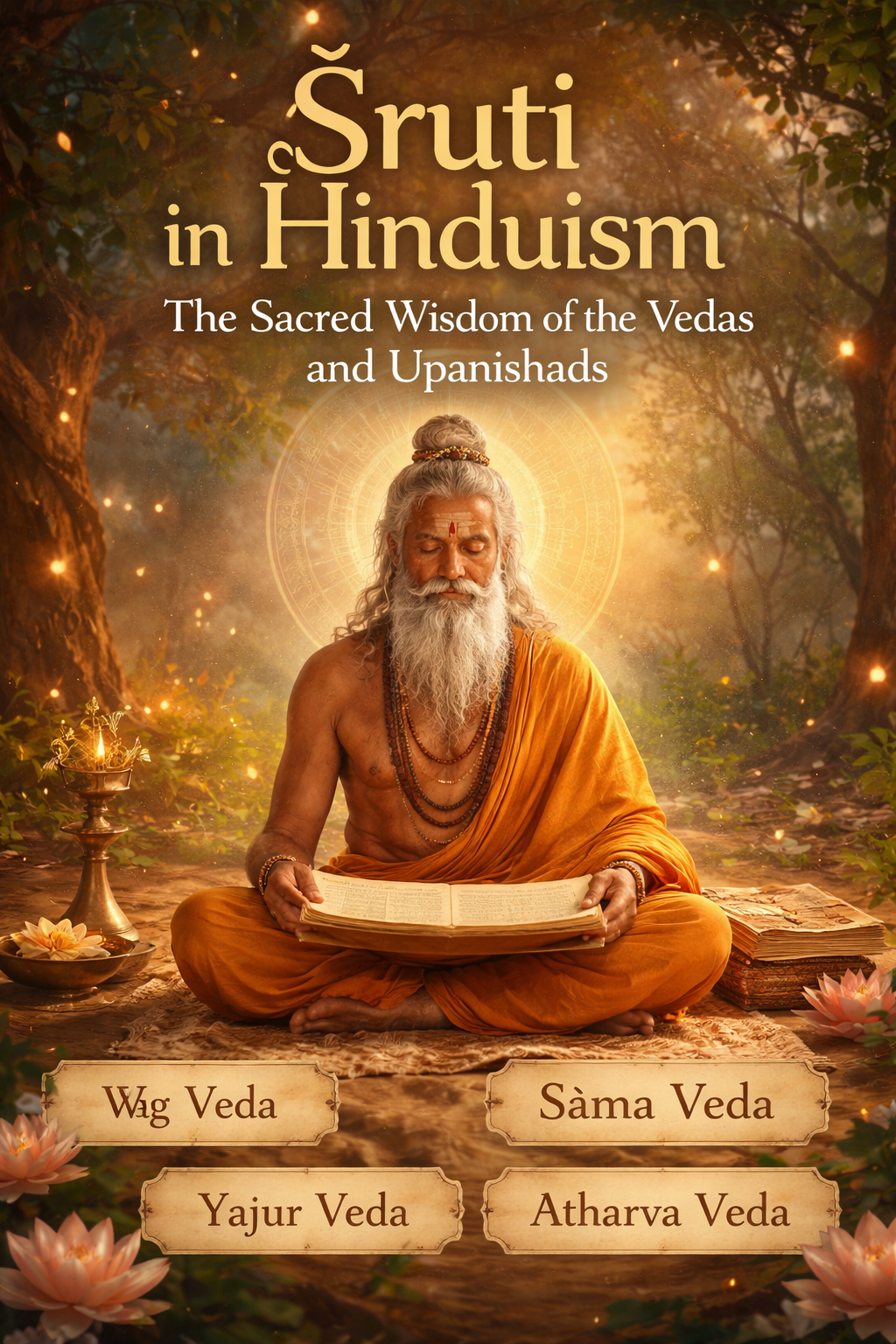
When we speak about Śruti, we mainly speak about the Vedas.
The Vedas are traditionally divided into four great collections:
-
Ṛg Veda
-
Sāma Veda
-
Yajur Veda
-
Atharva Veda
These texts contain hymns, ritual formulas, chants, and prayers… but above all, they carry a vision of the world where everything is connected.
In this vision, the universe is not chaos. It is a living order, a cosmic harmony, often called Ṛta (ऋत).
3) The Upaniṣads: when Śruti becomes silence
At the heart of the Śruti, there is a part that deeply touches many spiritual seekers: the Upaniṣads.
The Upaniṣads are sometimes called the end of the Vedas (Vedānta). They do not speak only about rituals, but about a burning question:
Who am I, truly?
They whisper that behind the noise of the mind, behind identity, behind fear… there is a presence.
And this presence is connected to the Absolute.
The Upaniṣads often teach that:
-
Ātman (the deep Self) is not separate from
-
Brahman (ultimate reality)
And when you understand this—not only with the head, but with your whole being—you start breathing differently.
As if life is no longer a fight… but a return.
4) Why are the Śruti sacred?
The Śruti are not sacred only because they are ancient.
They are sacred because they invite an inner attitude:
-
listening
-
humility
-
presence
In the tradition, you do not “consume” the Śruti.
You approach it like you approach a fire:
-
with care,
-
with respect,
-
with a kind of purity of intention.
Because this fire is not here to shine in our hands…
It is here to illuminate the heart.
5) Śruti and Smṛti: the source and the path
In Hinduism, we often speak about two categories:
-
Śruti: what is heard (revelation)
-
Smṛti: what is remembered (traditions, stories, laws, epics)
Smṛti includes for example:
-
the Bhagavad-Gītā
-
the Rāmāyaṇa
-
the Mahābhārata
-
the Purāṇas
Śruti is like a mountain spring.
Smṛti is like the river that flows into villages, nourishes fields, and joins daily life.
Both are precious.
But Śruti keeps a special quality: it feels like a truth that does not depend on time.
6) A modern way: hearing the Śruti today
You do not need to be a Sanskrit specialist to feel something when you come close to Śruti.
Even if you do not read the Vedas directly, you can live the spirit of Śruti through a simple practice:
🌿 Deep listening
-
listen to your breath
-
listen to the silence between two thoughts
-
listen to life without judging it
Because deep down, Śruti reminds us:
What you seek is not always far away.
Sometimes, it is more intimate.
More discreet.
Closer than your own name.
And in that space, there is a peace that does not depend on circumstances.
7) Cassie and the wisdom that is heard (a gentle little wink)
Sometimes, wisdom does not arrive with complicated words.
Sometimes, it arrives in a very simple moment:
-
a cat stretching slowly,
-
a gaze that does not judge,
-
a breath that settles.
Cassie, without knowing it, teaches us this listening too.
She does not try to understand the universe.
She lives inside it.
And maybe that is, deep down, the spirit of Śruti:
to live reality with presence.
Conclusion: Śruti, a door to the infinite
The Śruti are not only a religious heritage.
They are an invitation.
An invitation to listen differently:
-
listen to the world,
-
listen to the soul,
-
listen to what is greater than us…
And maybe one day, to hear inside yourself a silent, ancient, pure sentence:
“You are already connected.”
Ajouter un commentaire
Commentaires