

Hinduism 🌺 — Sacred Texts for the Heart
There are traditions that speak loudly.
And then there is Hinduism… which sometimes speaks like a breath.
Not a speech.
Not a lesson.
More like a presence.
As if, behind the words, something is looking at you gently.
And saying: “You are not lost. You are on your way.”
Today, I don’t want to give you a class.
I want to take you into a reading that soothes.
A walk through a few sacred texts of Hinduism — not to “understand,” but to feel.
🌙 1) The Vedas: the birth of the chant
The Vedas are not only books.
They are like the first vibrations of an inner world.
People sometimes say they are hymns.
But I feel them more like ancient lamps.
Sentences that don’t explain everything…
but that light up just enough for you to take one step.
When you come close to them, you don’t need to be a scholar.
You just need to be available.
Available like you are in the evening,
when the light fades,
and silence begins to make room.
🔥 2) The Upanishads: the gentlest question
The Upanishads dare to ask:
“Who am I… beyond what I tell myself?”
Not to do philosophy.
But to return to the heart.
The Upanishads often speak of the Atman.
That intimate, deep, silent part.
And they also whisper something vast:
“What you are searching for outside… already exists inside.”
So sometimes, while reading them,
I feel something strange and beautiful:
as if I am coming home.
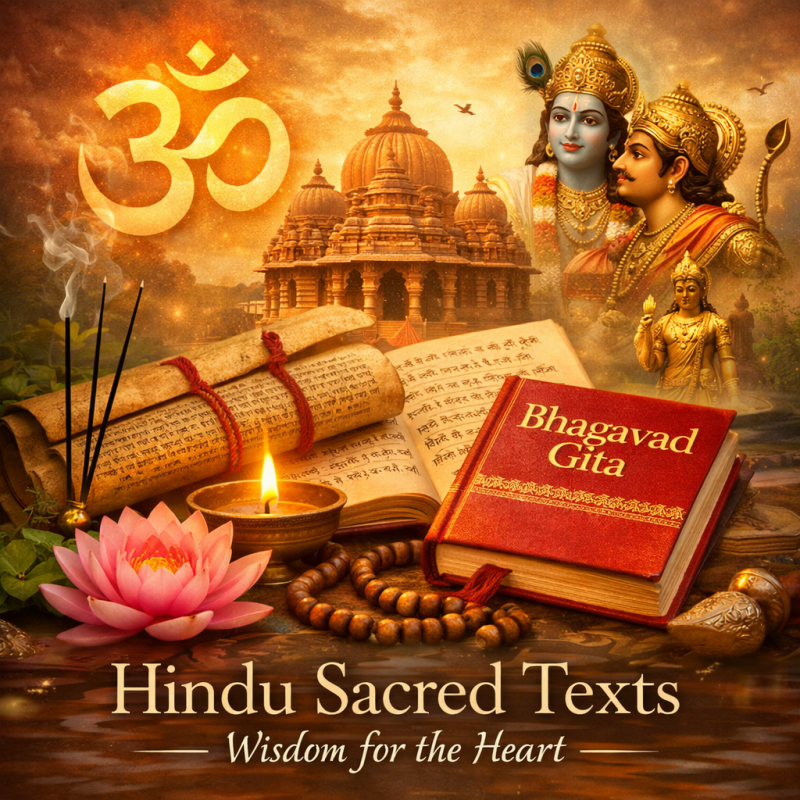
🕯️ 3) The Bhagavad Gītā: when life trembles
The Bhagavad Gītā is a simple and immense scene.
A human being is afraid.
He doubts.
He trembles.
And in the middle of that trembling,
a voice does not judge him.
It doesn’t say: “be strong.”
It says instead:
“Breathe. Look. And move forward with love.”
What I love about the Gītā
is not the idea of having to “succeed in life.”
It is the idea of doing your best,
with an honest heart,
and leaving the rest to mystery.
Like an offering.
🌊 4) The Rāmāyaṇa: faithfulness to the light
The Rāmāyaṇa is a story.
But a story that feels like a mirror.
You see loyalty.
Courage.
Trials.
And above all:
the way light continues to exist,
even when the road becomes long.
It doesn’t say:
“Life will be easy.”
It says:
“Even in the night, there is a direction.”
🌸 5) The Mahābhārata: the soul in the middle of chaos
The Mahābhārata is vast.
Very vast.
But deep down,
it speaks about something everyone knows:
difficult choices.
Relationships.
Wounds.
Misunderstandings.
And this quiet question:
“How do we stay true… when everything is complicated?”
It doesn’t give perfect answers.
It gives a more human truth:
you can fall,
make mistakes,
and still,
return toward what is good.
🐚 A short meditation (read slowly)
If you want, take 30 seconds.
Place one hand on your heart.
The other on your belly.
Breathe in.
And imagine that each sacred text is not a page.
But a door.
A door toward:
-
more gentleness
-
more patience
-
more peace
Breathe out.
And repeat inside:
I don’t need to understand everything.
I just need to remember what matters.
🌼 What sacred texts truly say
When I read them,
I feel like they don’t ask me to become someone else.
They simply ask me to remember.
To remember that life is sacred.
To remember that love is a practice.
To remember that awareness is a refuge.
And to remember…
that I can begin again.
Even today.
Even gently.
✨ Conclusion: reading like lighting a candle
Hinduism is not only a tradition.
It is a space.
A space where the divine is not far.
It is close.
It is intimate.
And sometimes,
it slips into a sentence.
A sentence that, at the right moment,
makes you feel good.
Like a cat who comes to lie down near you,
asking for nothing.
Just there.
Present.
Ajouter un commentaire
Commentaires