

Living Hinduism: Cassie, the Breath, and Me
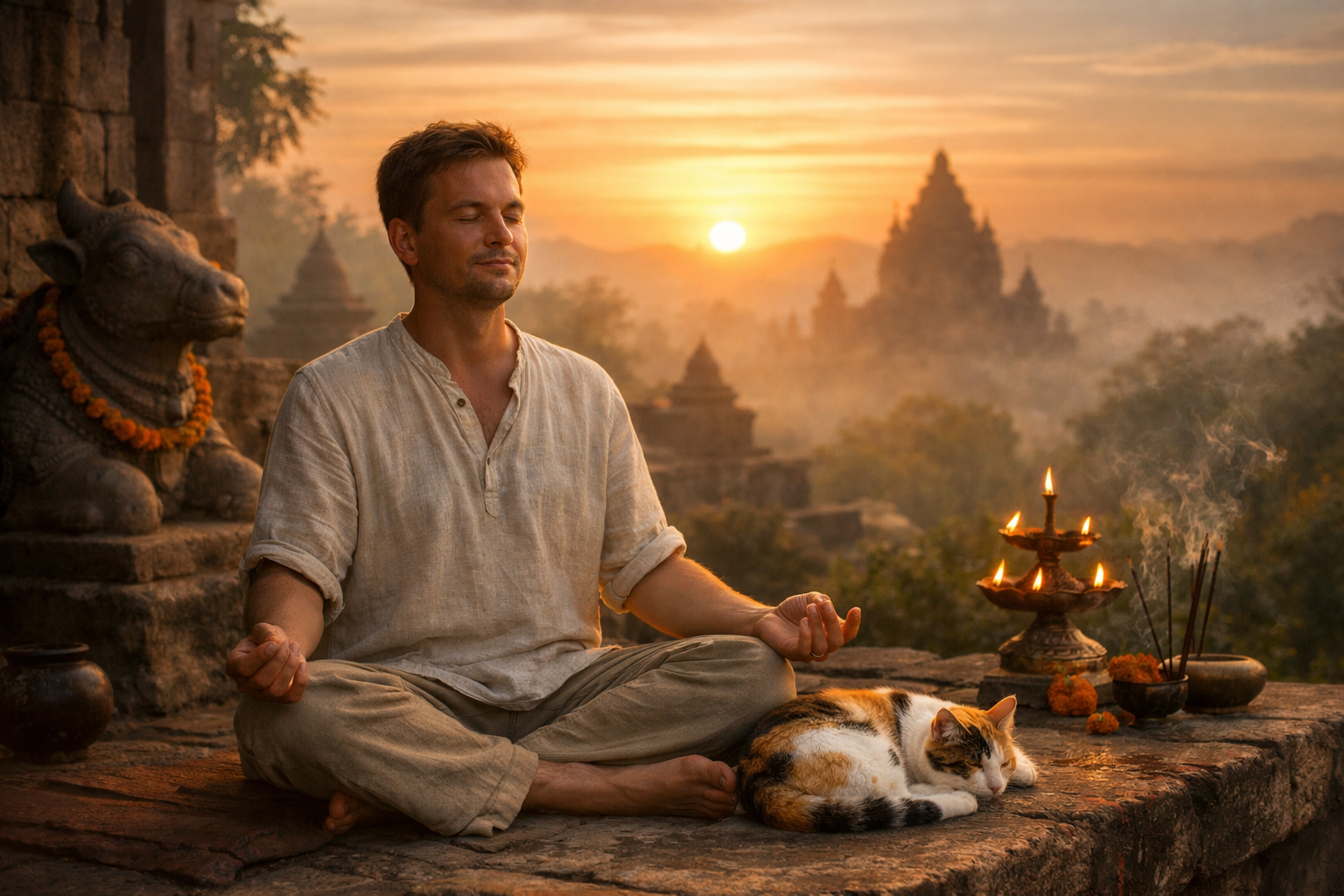
There are traditions you do not learn only from books. You feel them. You live them. Hinduism is one of these traditions. For me, it is not a fixed religion, but an ancient, slow, deep river that continues to flow through the world — and sometimes, quietly, through the living room… when Cassie sleeps nearby.
This article is neither a lesson nor an absolute truth. It is a living testimony, humble, rooted in daily practice, conscious breathing, observation, and the intimate bond between human beings, animals, and the sacred.
Hinduism: a path, not a dogma
Hinduism does not begin with a single founder. It does not impose a mandatory belief. It offers an experience.
It is a plural tradition, made of many paths:
-
knowledge (jnana),
-
right action (karma),
-
devotion (bhakti),
-
inner discipline (yoga).
Each person walks at their own rhythm, according to their nature.
When I meditate, when I breathe slowly, I do not always recite complex mantras. Sometimes, I simply stay there. Present. Like Cassie.
She does not seek awakening. She is.
Cassie, the silent teacher
Cassie knows neither the Vedas nor the Upanishads. And yet…
When she stretches in the sunlight, fully absorbed in the moment, she embodies what so many texts try to describe:
unity between body, breath, and the present moment.
In Hinduism, the divine is not separate from the world. It is immanent.
Watching Cassie breathe softly during meditation has often reminded me of this:
-
the sacred is not elsewhere,
-
it is in the living,
-
in natural rhythm,
-
in simplicity.
She teaches me, without words, the most ancient yoga: pure attention.
Brahman, Atman… and the breath
Hinduism speaks of an ultimate reality: Brahman.
Not a personal god, but infinite consciousness, the source of everything.
And at the heart of every being, there is Atman — the inner breath, the essence.
In meditative practice, especially when I guide simple meditations (A1–A2), I always return to the breath. Because breath connects.
To breathe is already to pray.
Cassie does not separate breath from life. She breathes, therefore she is. And in this simple act, she touches something deeply Hindu:
the unity of all living beings.
Shiva: transformation and silence
Shiva is not only the destroyer. He is the transformer.
He destroys illusion, not life.
When I go through periods of doubt, fatigue, or questioning in my journey (blog, training, creation), I often think of Shiva, motionless in meditation.
True change is born in silence.
Cassie, when she withdraws to a quiet corner, does the same. She knows when it is time to stop.
In a world that pushes us to produce more and more, Hinduism reminds us of this:
conscious rest is sacred.
Everyday non-violence
Ahimsa — non-violence — is not a grand declaration. It is a repeated choice.
Being gentle with oneself.
Respecting the body.
Being mindful of words.
And also:
-
listening to one’s animal,
-
respecting their rhythm,
-
recognizing that humans are not the center of everything.
Cassie does not see me as a master. I am a companion.
Hinduism teaches us this: hierarchy is an illusion.
An embodied spirituality
I am not trying to “become Hindu” in an identity sense.
I live with Hinduism.
In meditation.
In sophrology.
In mindfulness.
In the creation of images, texts, and silences.
And sometimes, in a simple exchanged glance with Cassie.
That is when I truly understand:
the divine does not ask to be understood, only to be lived.
Sacred texts as whispers, not laws
In Hinduism, there are many texts: the Vedas, the Upanishads, the Bhagavad Gita, the Puranas. But what has always struck me is not their authority — it is their flexibility.
They do not say: “believe.” They say: listen.
The Upanishads sometimes feel like conversations by the fire, between a teacher and a student, between a question and a silence. Nothing is rushed. Nothing is imposed.
When I reread certain passages, I do not try to understand everything. I let them resonate, like a sound fading after a singing bowl.
Cassie always reacts to tone, never to content. She taught me that truth often passes through vibration, not through intellectual meaning.
Circular time: learning not to rush
Hinduism does not see time as a straight line. It is cyclical.
Creation, preservation, dissolution.
Again and again.
This vision deeply calmed me. It removes the anxiety of “succeeding fast” or “missing one’s life.” Everything returns. Everything departs.
When Cassie plays, gets tired, falls asleep, and then wakes again… she already lives in this circular time. She does not regret yesterday. She does not anticipate tomorrow.
In my practice of sophrology and mindfulness, I often return to this idea:
you are not late, you are in a cycle.
The body: a living temple
Unlike traditions that distrust the body, Hinduism recognizes it as a sacred vehicle.
The body breathes.
The body feels.
The body knows.
Meditation is not an escape from the body, but a reconciliation.
When I sit to practice, I no longer try to “sit perfectly straight.” I listen. I adjust. I respect.
Cassie never forces a posture. If she is uncomfortable, she naturally changes position.
What an immense teaching.
Simple devotion: loving without a perfect image
Bhakti — the path of the heart — has always touched me.
No need for a complex altar.
No need for grand rituals.
Devotion can be silent, intimate, almost invisible.
Lighting a candle.
Breathing consciously.
Speaking softly.
Taking care of an animal.
When I prepare a meditation, even a very simple one, I place this intention there: to offer, not to perform.
Cassie immediately senses whether I am rushed or present. She then becomes my mirror.
Samsara and suffering: looking without fleeing
Hinduism does not deny suffering. It recognizes it as part of conditioned existence.
But it does not dramatize it.
Suffering becomes a teacher.
When a thought keeps returning, when fatigue persists, I no longer try to chase it away immediately. I observe it.
Cassie does the same with an unfamiliar sound: she looks, she listens, then she decides.
Liberation often begins with this pause.
Meditating without seeking awakening
One of the greatest spiritual traps is the obsessive search for awakening.
Hinduism whispers something else:
live fully; awakening will come or it will not.
In my meditations, I no longer try to reach a special state. I guide toward ordinary presence.
Breathing.
Listening.
Feeling.
Cassie does not meditate to progress. She meditates because it is natural.
The animal as a spiritual being
Hinduism has always recognized continuity between forms of life.
The animal is not inferior.
It is different.
Cows, monkeys, snakes, cats — all carry symbolism, but above all, presence.
Living with Cassie strengthened this certainty in me: spirituality cannot be anthropocentric.
Observing an animal is observing a non-verbal wisdom.
Creating as a spiritual act
Writing.
Creating images.
Preparing a meditation.
All of this can become a spiritual act if the intention is right.
I do not create to convince. I create to share a state of being.
Hinduism does not separate art, life, and the sacred.
Cassie sometimes walks across the keyboard. And I smile.
Even chaos has its place.
Walking on, slowly
I do not know where this path leads.
And that is perfectly fine.
Hinduism taught me to walk without a definitive map.
With the breath.
With the living.
With Cassie.
If this text accompanies you for a moment, then it has already fulfilled its purpose.
Breathe.
The rest will follow.
Ajouter un commentaire
Commentaires