

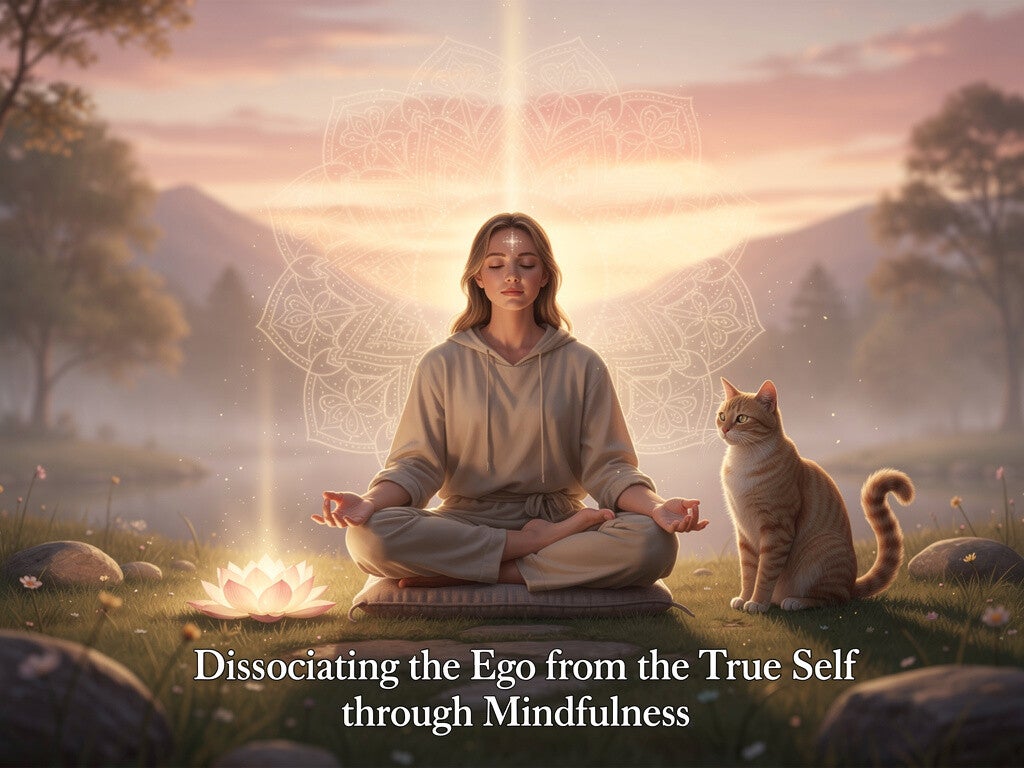
Dissociating the Ego from the True Self through Mindfulness
Mindfulness is a practice that invites us to live in the present moment, to observe our thoughts and emotions without judgment. In this quest for consciousness, a fundamental question arises: how to dissociate the ego from the True Self? The ego, that inner voice that identifies us with our thoughts and emotions, can often distance us from our true essence. But what is the True Self? And how can mindfulness help us discover it?
The Practice of Mindfulness to Dissociate the Ego from the True Self
Mindfulness teaches us to observe our thoughts and emotions without attaching to them. By practicing meditation and mindfulness, we can begin to recognize that our thoughts and emotions do not define who we are. They are simply phenomena passing through our minds.
Recognizing the Ego
The ego is that part of us that identifies with our thoughts, emotions, possessions, and achievements. It is often linked to our feeling of separation and superiority or inferiority in relation to others. For example, when we feel proud of our achievements or ashamed of our failures, it is often the ego speaking. The ego feeds on these identifications and distances us from our true essence.
Observing Without Judgment
Mindfulness encourages us to observe our thoughts and emotions without judgment. This means that we do not identify with these thoughts and emotions, but rather observe them as clouds passing in the sky. By practicing this non-judgmental observation, we can begin to see that our thoughts and emotions are not who we are, but simply temporary experiences.
Connecting with the True Self
The True Self is that part of us that is beyond the ego. It is our essence, our pure consciousness. By practicing mindfulness, we can begin to connect with this part of ourselves. The True Self is often described as a state of inner peace, joy, and connection with something greater than ourselves.
My Cat and His Perspective on the Ego
My cat has shown spiritual behavior since a young age. He responds to mantras by coming into the room (considered his temple), forms a triangle with his paw (imitating a prayer gesture towards Shiva), and also responds to the name 'Parvati' by looking at me and approaching, as if recognizing a special reference.
My Cat's Spiritual Behavior
My cat has shown spiritual behavior since a young age. He responds to mantras by coming into the room (considered his temple), forms a triangle with his paw (imitating a prayer gesture towards Shiva), and also responds to the name 'Parvati' by looking at me and approaching, as if recognizing a special reference. This behavior suggests that my cat has an intuitive understanding of spirituality and connection with something greater.
The Intuitive Wisdom of My Cat
Perhaps my cat, with his intuitive wisdom, reminds us that the True Self is beyond the ego. He shows us that spirituality is not just a matter of thought, but also of feeling and connection with something greater than ourselves. By observing my cat, we can learn to be more present, to listen to our intuition, and to connect with our true essence.
Conclusion and Final Reflection
By practicing mindfulness and observing our ego without judgment, we can begin to connect with our True Self. My cat, with his intuitive wisdom, reminds us that this connection is possible for everyone, even for a cat. Mindfulness offers us a path to dissociate the ego from the True Self and to discover our deep essence.
The practice of mindfulness invites us to live in the present moment, to observe our thoughts and emotions without judgment. By recognizing the ego and connecting with our True Self, we can find inner peace and deep joy. My cat, with his intuitive wisdom, reminds us that this connection is possible for everyone, and that spirituality is a matter of feeling and connection with something greater than ourselves.
Ajouter un commentaire
Commentaires