

Introduction: A Question as Vast as the Sky
This morning, as Cassie, my four-legged companion, stretched beneath the first rays of sunlight filtering through the branches of the plane tree, I caught myself whispering: "What is Hinduism, really? A religion? A philosophy? Or simply a way of being in the world?" Her half-closed eyes, her deep purring like a natural mantra, reminded me that the deepest answers are not always found in books, but in the very experience of life. Hinduism is a bit like Cassie: impossible to confine to a single definition. It is a river with a thousand currents, a forest with endless paths, a sky where every star—like Sirius, still shining at dawn—tells a different story.
1. Hinduism: A Religion of Many Faces
If we were to classify it, Hinduism would undoubtedly be the world’s oldest "religion," with roots reaching back to the Vedas, sacred texts composed over 3,000 years ago. Yet, the word "religion" feels too narrow to contain it. Hinduism has no single dogma, no founder, no central authority. It unfolds as a mosaic of beliefs, rituals, and traditions, as varied as the leaves of our plane tree.
-
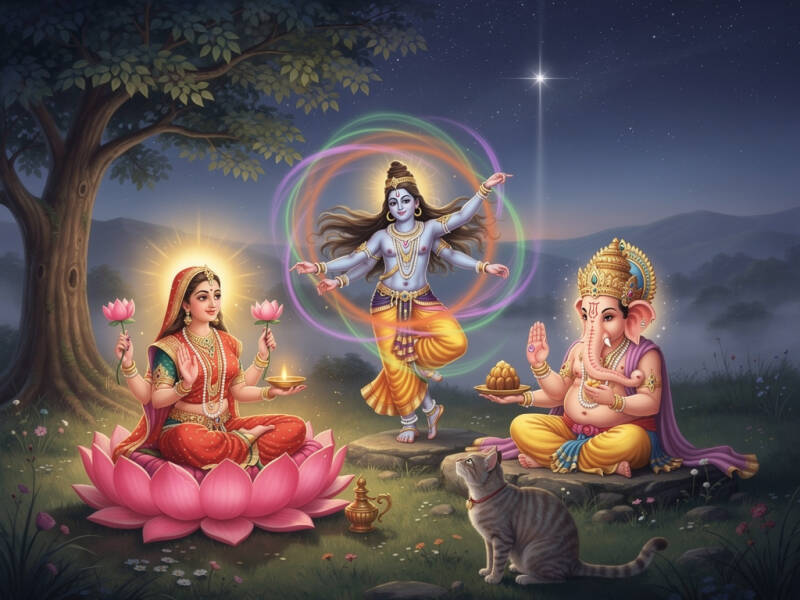
The Gods and Goddesses: Shiva, the cosmic dancer who destroys to rebirth; Lakshmi, the goddess of prosperity, whose lamp lit every Friday illuminates our evenings; Ganesha, the elephant-headed deity, who watches over new beginnings... Each deity embodies a facet of the absolute, like the shifting reflections of light on Cassie’s fur.
-
Sacred Texts: From the Vedas to the Upanishads, and the Bhagavad Gita—that dialogue between Krishna and Arjuna on the battlefield of Kurukshetra—each text offers a key, never a single door. The Gita, for example, speaks of dharma (righteous duty) and karma (selfless action), concepts I try to apply when I pet Cassie without expecting affection in return, simply because it is right.
-
Rituals: Lighting a lamp for Lakshmi, celebrating Maha Shivaratri while meditating with Cassie curled up beside me, or offering flowers to Ganesha... These gestures are not obligations, but invitations to sanctify the everyday.
But beware: these practices are not fixed rules. They adapt and evolve, much like Cassie, who chooses a new spot every morning to watch the birds.
2. A Philosophy of Life, Beyond a System of Beliefs
Hinduism is also a philosophy, a way of questioning existence. Its great concepts—moksha (liberation), samsara (the cycle of rebirth), atman (the universal soul)—do not demand blind adherence, but personal exploration.
-
Dharma: It is not an imposed morality, but a unique path for each of us. Mine unfolds through writing, meditating with Cassie, and observing the stars. Hers seems to be teaching me patience as she gazes at a sparrow for hours.
-
Karma: Not a punishment, but a lesson. Every action, every intention, weaves our destiny. When Cassie wakes me at dawn to watch the sky, I see it as an invitation to act with awareness, without attachment to the outcome—as Krishna advises Arjuna.
-
Advaita (Non-Duality): The idea that all is One, that the separation between me, Cassie, the plane tree, and Sirius is but an illusion. This idea takes on its full meaning when I feel her breath sync with mine during our meditations.
3. A Lived, Sensory, and Poetic Spirituality
Perhaps this is where the magic of Hinduism lies: it is not lived only in temples, but in every moment. With Cassie, it becomes a sensory practice:
-
Mindfulness: Watching her paws tread the grass, listening to her purring as a mantra, feeling the softness of her fur... So many gateways to the present.
-
Nature as Temple: The balcony is our sanctuary. The birds, our priests; the wind, our incense; the moon, our benevolent deity.
-
Mantras and Chants: Om Namah Shivaya whispered while stroking Cassie, or the chants of Tibetan monks that lull our evenings. These sounds are not prayers, but vibrations that connect us to the universe.
4. Cassie, My Spiritual Guide
She doesn’t read the Vedas or recite the sutras, and yet... Cassie embodies Hinduism better than anyone. She teaches me:
-
Letting Go: Like Shiva, she destroys (my cushions) to be reborn (curled up on my lap).
-
Compassion: Her gaze when I am sad is a lesson in mettā (loving-kindness) more powerful than any sermon.
-
Impermanence: Her falling fur, her changing moods, remind me that everything is fleeting—sic transit gloria mundi, as the Buddhists also say.
5. An Invitation to Dance
So, religion or philosophy? Hinduism is both, and so much more. It is a dance, like Shiva’s, uniting and transcending opposites. A dance where every step—whether a ritual, a reflection, or a moment shared with Cassie—brings us closer to ourselves and the whole.
Tonight, as I light the lamp for Lakshmi, I will smile, thinking of this line from the Bhagavad Gita: "Perform your duty, but let go of the fruits of your actions." What if true spirituality were simply to act with love, like Cassie, who, without a word, guides me toward the light?
Shanti Om ✨
To Go Further:
-
Meditate with animals: sync your breath with theirs, as a silent offering.
-
Create an ephemeral altar: a leaf, a stone, a feather... and the presence of your four-legged companion.
-
Observe the stars: Sirius, the moon, or simply the clouds. The universe is our greatest guru.
"Truth is one. The wise call it by many names." — Rig Veda
Ajouter un commentaire
Commentaires