

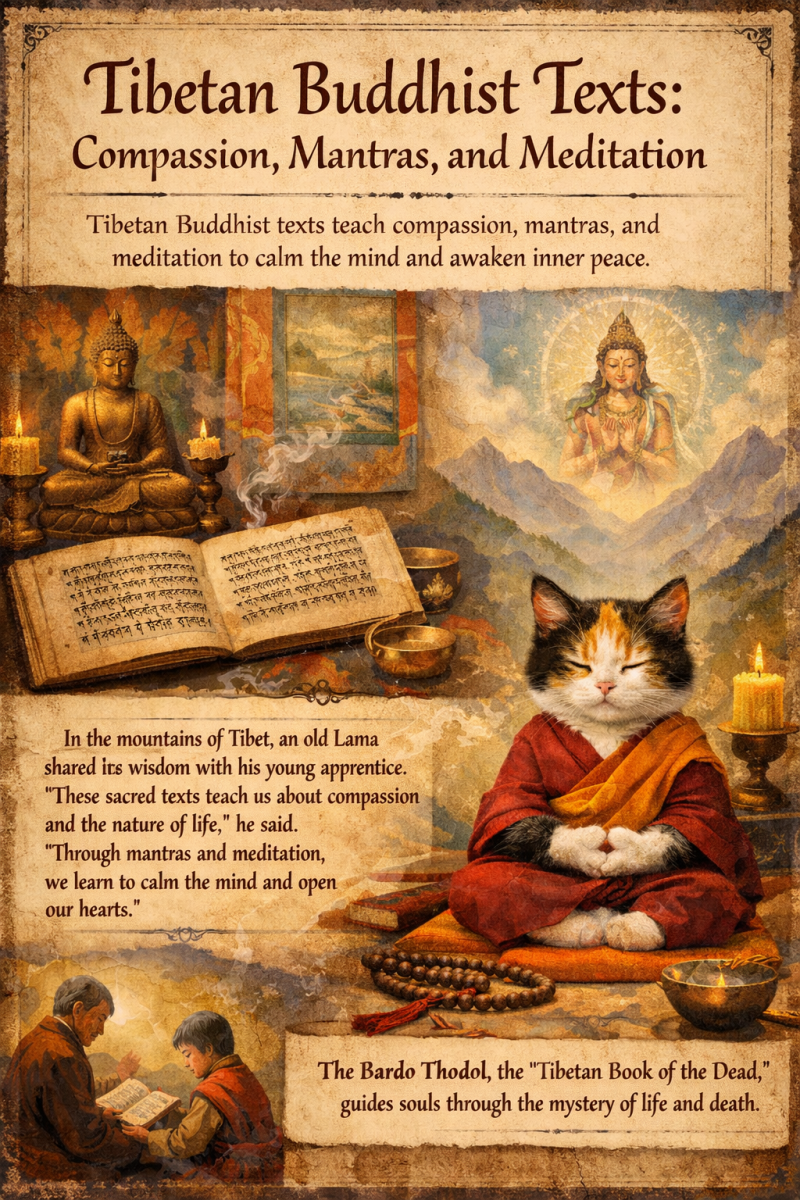
Tibetan Buddhist Texts: Compassion, Mantras, and Meditation 🕯️🐾
In the mountains where the air is thin and the sky is immense, there are words that travel through centuries like a silent song. Tibetan Buddhist texts are not only old books: they are inner maps, lamps placed on the path, prayers that teach the heart to stay gentle even when life becomes hard.
And in my daily life, I often discover that these teachings do not live only in monasteries… but also in a living room, on a meditation cushion, with a cat stretching as if the whole world is already at peace.
Cassie, my little Zen teacher, does not read sutras… but she understands them in her own way: with presence.
1) Tibet: when spirituality becomes a breath
Tibetan Buddhism is a land of contrasts: snow, the flame of butter lamps, prayer flags snapping in the wind, and this deep conviction that the mind can awaken here and now.
Tibetan texts do not try only to explain: they try to transform.
They speak about:
-
compassion (for yourself, for others)
-
emptiness (reality is not as solid as we think)
-
meditation (as an art of returning)
-
mantras (seeds of peace)
-
karma (not as a punishment, but as responsibility)
And when we read them slowly, we feel one thing:
The goal is not to be perfect.
The goal is to be true.
2) A story: the night Cassie became my little lama 🐾
There are evenings when the mind spins too fast.
The body is tired, but the head refuses to sleep.
Thoughts come back like restless birds: they land, they fly away, they come back again.
That night, I had this strange feeling: being far from myself.
So I turned on a small light.
I breathed.
And I opened a Tibetan text that I love for its simplicity.
Not a complicated text.
Not a text that tries to impress.
A text that comforts.
I was reading softly, like you would soothe a child who is crying.
And Cassie came.
Without a sound.
She sat next to me, then she placed a paw on my knee.
That gesture…
It was a sentence.
Not in French.
Not in Tibetan.
But a clear sentence:
“Stay here.”
I stopped reading.
I looked at her.
She blinked slowly, as if she was reciting a secret mantra.
And I understood something:
Tibetan texts do not ask to be understood with the brain.
They ask to be received.
3) Sutras and teachings: mirrors for the mind
In the Tibetan tradition, we find fundamental texts coming from Indian Buddhism, then transmitted and commented on.
We often meet powerful ideas, like:
✦ Compassion (Karuna)
Compassion is not pity.
It is a quiet strength.
A presence that says:
“I see you. And I won’t leave you alone.”
Cassie does this naturally.
When I am sad, she does not make speeches.
She comes.
She stays.
And that is enough.
✦ Emptiness (Shunyata)
This word can feel scary sometimes.
We think “emptiness” means “nothing.”
But in experience, emptiness is more like:
Nothing is fixed.
Nothing is permanent.
Everything can change.
Even an emotion.
Even a fear.
Even a dark day.
And Cassie often reminds me of that.
She can be stressed for one minute… then, the next moment, she falls asleep like a little Buddha curled into a ball.
✦ Impermanence
Tibetan texts speak a lot about impermanence.
Not to make us sad.
But to wake us up.
Because if everything passes…
Then this moment is precious.
Even a simple moment.
Even a bowl of water.
Even a shared silence.
4) Mantras: seeds planted in the heart 🔔
In Tibetan Buddhism, mantras are like sacred formulas.
But beyond the words, they are vibrations that bring the mind back home.
A mantra is not magical like a spell.
It is magical like a breath.
It reminds you:
“You can return. You can calm down.”
When I sing softly, Cassie calms down.
She listens.
She lies down.
As if she were saying:
“Yes. That’s it. Keep going.”
And I understand:
The mantra does not change the world.
It changes the way I am in the world.
5) The texts of the heart: the Bardo Thödol and transformation
Among the most well-known Tibetan texts, there is a book often called:
The Tibetan Book of the Dead (Bardo Thödol).
Many people think it is a text only about death.
But in reality, it is also a text about life.
It speaks about bardos, these states of transition.
And I believe we go through bardos every day:
-
when we leave an old version of ourselves
-
when we heal from a wound
-
when we come out of a period of fatigue
-
when we change direction
A bardo is a passage.
And sometimes, in these passages, we need a gentle presence.
Cassie is my gentle presence.
6) A simple practice inspired by Tibetan texts (with Cassie) 🧘♂️🐈
Here is a mini practice you can do in 3 minutes.
Step 1: posture
Sit comfortably.
Place one hand on your heart.
If your cat comes, let them be there.
If they don’t come, it’s ok.
Step 2: breathing
Breathe in softly.
Breathe out slowly.
Repeat 3 times.
Step 3: awakening phrase
Say inside:
“Like every living being, I want to be at peace.”
Then:
“Like every living being, I deserve gentleness.”
Step 4: offering
Offer a thought of kindness to someone.
Even just one person.
And finish with:
“May I be useful.”
Cassie, she often finishes with a nap.
And maybe that is wisdom too.
Conclusion: Tibetan texts are not far… they are here 🌙
Sometimes we imagine Tibetan wisdom is unreachable.
That it belongs to masters, to temples, to mountains.
But I believe it is also in:
-
a conscious breath
-
a tear that is welcomed
-
a whispered mantra
-
a cat falling asleep against you
Tibetan texts are deep.
But their message is simple:
Wake up.
Love.
Breathe.
And begin again.
And if Cassie could speak, I’m sure she would add:
“And don’t forget to take a break… and drink some water.” 🐾💧
Ajouter un commentaire
Commentaires