

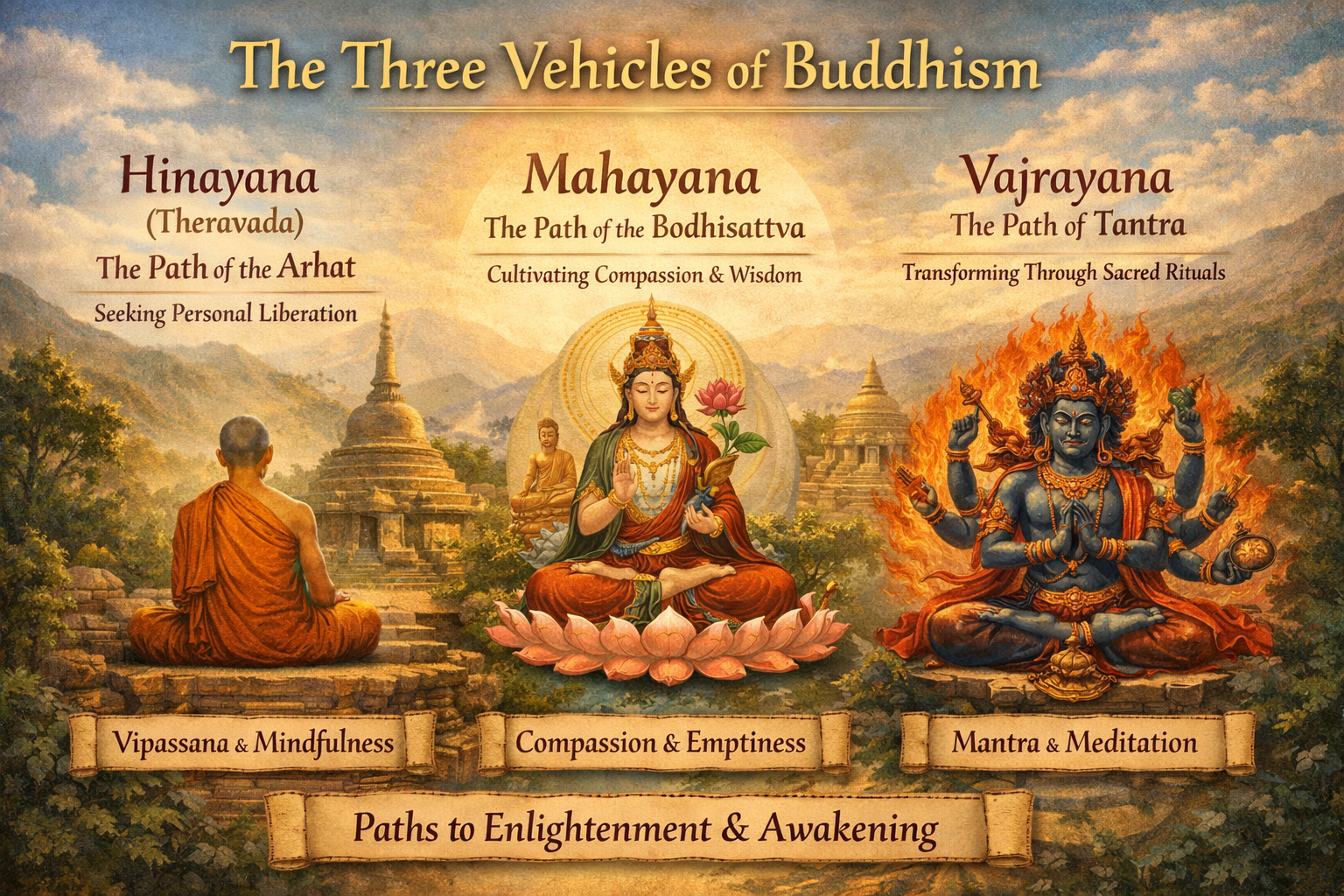
Buddhism — The Three Vehicles: Hinayana (including Theravada), Mahayana, and Vajrayāna 🌿
In Buddhism, people often speak about the “Three Vehicles” (in Sanskrit yāna, meaning “a way to cross”).
A vehicle is not a rigid label: it is a path, a way of walking toward awakening.
You can imagine three great ways to cross the same river:
-
one focuses on inner discipline and personal liberation,
-
another on universal compassion and awakening for all beings,
-
and the third on deep and powerful methods, transforming the mind by using the energies of life itself.
Each path has its own beauty, wisdom, and depth. And most importantly: they can respect each other, support each other, and sometimes meet in the same open space of truth.
1) Hinayana: the path of liberation through simplicity 🕯️
The word Hinayāna literally means “small vehicle.”
Today, this term can feel negative when used to describe other traditions.
That is why it is often better to speak about Theravāda (“Teaching of the Elders”) when referring to the best-known living tradition in this family.
🌾 The heart of this path
This approach is like a lamp in the night: simple, direct, steady.
It highlights:
-
ethical discipline (sīla),
-
concentration (samādhi),
-
wisdom (paññā),
-
and very careful observation of inner experience.
The goal is often described as becoming an arhat: a person who is free from illusions and attachments, who has extinguished the causes of suffering.
🌬️ A living practice
Theravāda strongly values:
-
vipassanā meditation (insight),
-
mindfulness of breathing,
-
attention to the body, sensations, and thoughts,
-
and a gentle but sharp clarity.
It is a patient path:
like polishing a stone until it becomes clear.
✨ Its wisdom
It teaches:
-
everything is impermanent,
-
attachment creates suffering,
-
and peace grows when we stop fighting reality.
2) Mahayana: awakening as a promise for all beings 🌸
Mahāyāna means “great vehicle.”
Here, the path becomes vast:
not only to free oneself, but to awaken for the benefit of all beings.
🌺 The Bodhisattva vow
At the heart of Mahayana is the ideal of the bodhisattva:
a being who chooses to cultivate awakening, wisdom, and compassion, and who makes the vow not to abandon others on the path.
A bodhisattva is not a perfect saint.
It is a heart in motion, a tender courage.
🌈 Compassion and emptiness
Mahayana rests on two pillars:
-
compassion (karuṇā),
-
and the wisdom of emptiness (śūnyatā).
Emptiness is not nothingness.
It is the teaching that things do not exist in a separate and fixed way.
Everything is interdependent, moving, relational.
It is like discovering that the world is not made of solid objects,
but a dance of conditions.
📜 Powerful texts and luminous figures
Mahayana is rich in sutras, such as:
-
the Heart Sutra,
-
the Lotus Sutra,
-
the Avatamsaka Sutra,
-
the Prajñāpāramitā texts (Perfection of Wisdom).
It also offers inspiring figures:
-
Avalokiteśvara (compassion),
-
Mañjuśrī (wisdom),
-
Amitābha (infinite light).
✨ Its wisdom
Mahayana teaches:
-
awakening is an opening,
-
compassion is a form of intelligence,
-
and we become truly free when we stop believing we are alone.
3) Vajrayāna: transforming the mind through the Diamond Path ⚡
Vajrayāna is often called Tantric Buddhism.
The word vajra means “diamond” or “thunderbolt”:
something indestructible, sharp, and luminous.
This path is strongly linked with Tibetan Buddhism, though it also appears in other Buddhist histories.
🔥 A path of transformation
Vajrayāna does not only aim to calm the mind:
it seeks to transform what binds us.
Instead of rejecting emotions, desire, or fear, it sometimes uses them as energy for practice, with great precision.
This requires:
-
a strong ethical foundation,
-
training of the mind,
-
and often the guidance of a qualified teacher.
🧘♂️ Mantras, visualizations, mandalas
Vajrayāna uses powerful methods:
-
mantras (sacred sounds),
-
mudrās (symbolic gestures),
-
visualizations of deities (yidams),
-
mandalas,
-
and practices working with breath and subtle energy.
The “deities” here are not necessarily gods in a classical sense.
They are archetypes of awakening, mirrors of our own deepest nature.
🌌 Buddha-nature already present
A central idea is:
awakening is not far away. It is already here, but covered.
Vajrayāna acts like fire:
it does not build an outside light,
it reveals what was hidden.
✨ Its wisdom
Vajrayāna teaches:
-
the mind can be freed here and now,
-
the sacred can live inside daily life,
-
and clarity is possible even in the heart of intensity.
hree vehicles: separation or harmony? 🤍
It may look like these paths oppose each other.
In reality, they can be seen as different depths or different spiritual temperaments.
-
Theravāda reminds us of inner discipline, stability, and simplicity.
-
Mahayana reminds us of the vast heart, compassion, and emptiness.
-
Vajrayāna reminds us of direct transformation, symbolic power, and sacred vision.
No vehicle is “better” in an absolute way.
What matters is:
-
sincerity,
-
consistency,
-
and how practice makes your mind freer and your heart softer.
A simple image to understand them 🌊
Imagine three ways to cross an inner ocean:
-
Theravāda: you row calmly, moving forward with discipline and clarity.
-
Mahayana: you row, but you also bring others with you, through compassion.
-
Vajrayāna: you use the wind and lightning, transforming the energy of the storm itself.
The destination is the same:
the end of suffering, deep clarity, and true peace.
Conclusion: wisdom that breathes 🌿
The three vehicles are like three different songs for the same truth:
Know yourself, free yourself, love more widely.
And perhaps the most beautiful part of Buddhism
is not choosing a label,
but walking each day a little closer to clarity.
Ajouter un commentaire
Commentaires