

Introduction: A Spirituality with Four Paws and Five Deities
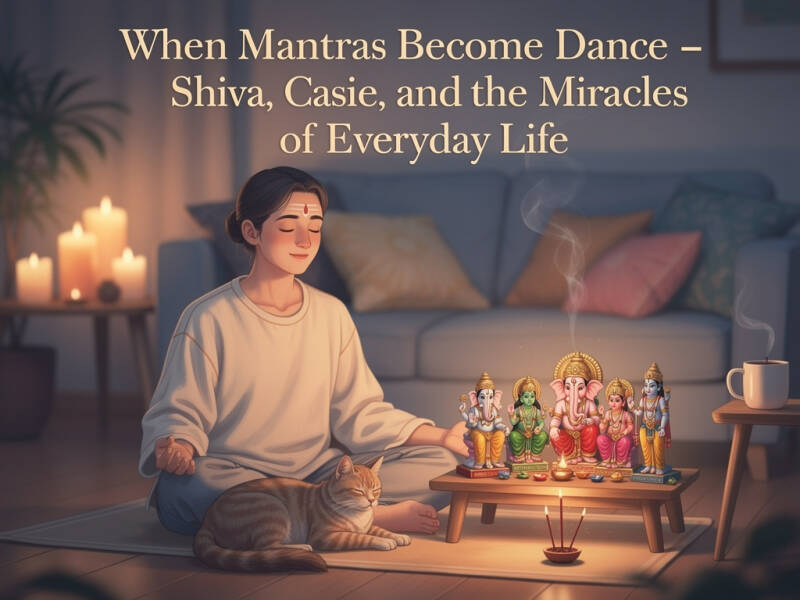
There are mornings when everything begins with a purr. Cassie, curled up against my legs, lifts her half-asleep gaze toward me, as if she already knows this day will be different. I sit cross-legged on the mat, a cup of coffee in hand—my ritual, the one that replaces temples and incense. I close my eyes, and the names rise within me, spontaneous and necessary: Shiva, Ganesha, Parvati, Ashokasundari, Krishna. These are not prayers in the traditional sense. They are acknowledgments. Whispers addressed to presences that I feel are listening without judgment, without expectation. And Cassie, she listens too. She may not understand the words, but she understands the energy—that vibration that arises when the heart and voice align.
I am not a scholar of Hinduism. I don’t master Sanskrit, nor do I know all the sacred texts by heart. My practice is made of fragments, intuitions, and moments stolen between daily tasks. It is alive, like a plant I water without knowing exactly how it grows, yet it blooms anyway. Because the gods, I’ve realized, do not demand perfection. They only ask that we make space for them—even if it’s just between the washing machine and the grocery list.
This article is the story of that space. Of those moments when the sacred slips into the ordinary, when a whispered mantra becomes a dance, when a cat becomes a meditation accomplice, and when miracles are not bolts of lightning from the sky but sparks in the everyday.
1. Shiva: The Fire That Purifies (Even on Gray Days)
Shiva, the destroyer, the transformer, the one who dances in the ashes to be reborn. When I first encountered him, it was through images: a third eye, a snake around his neck, a moon balanced on his tangled hair. He intimidated me. How could I approach such a powerful, radical deity?
Then I understood: Shiva does not destroy out of cruelty. He destroys what suffocates us to make way for what liberates us.
An example? Six months ago, I lost a project that was close to my heart. I had spent nights on it, pouring all my energy into it. And then, one email, a polite but final phrase: "We will not be moving forward." I cried. I raged. And then, in desperation, I sat in front of the small Shiva statue I had bought in a New Age shop and murmured: "I don’t understand. But if this is yours to take, take it." I lit a candle and chanted "Om Namah Shivaya" until my throat was dry.
The next day, a new idea came to me. Not as consolation, but as an obvious next step. A different project, more aligned with who I truly am. And Cassie, that day, slept on my lap for two hours straight—she who usually never stays still.
Shiva did not spare me the pain. But he taught me to move through it. To dance with it, just as he dances in the flames. Because destruction, sometimes, is just another word for rebirth.
Shiva’s Lesson:
Life is not a straight line. It is a dance—sometimes slow, sometimes frantic, sometimes chaotic. And it is in the chaos that the most beautiful things are born.
(A memory: That day, Cassie knocked over a vase. The water spilled on the floor, and as I wiped it up, I found a coin I thought I had lost. A wink? Maybe. A miracle? Probably not. But a sign that even in disorder, there is grace.)
2. Ganesha: The Lord of Obstacles (and My Fears)
Ganesha, with his elephant head and mischievous smile, became my ally against procrastination. "Om Gam Ganapataye Namaha," I repeat it like a mantra before every new task, every important email, every article I start with the fear of not being good enough.
There is something deeply reassuring about him. Maybe it’s that trunk that breaks barriers, or the rat, his vehicle, symbolizing the ability to gnaw through even the most stubborn problems.
One morning, I received a negative comment on my blog: "Your style is too personal, not professional enough." My stomach knotted. I placed my hands on my desk, closed my eyes, and imagined Ganesha sitting there, laughing. "So what?" he seemed to say. "Who decided that professional had to be cold and distant?"
I took a breath. I wrote a response—not to defend myself, but to explain why I wrote the way I did. And you know what? The person replied: "Okay, I see. Actually, it’s refreshing."
Ganesha does not make obstacles disappear. He gives us the courage to face them. And sometimes, he reminds us that these obstacles are just illusions.
Ganesha’s Lesson:
What blocks you today can become your strength tomorrow. You just have to dare to move forward, even if it’s with hesitant steps.
(Cassie, for her part, has her own way of helping: she sits on my keyboard when I’m stressed. Forced to pause, I laugh. And suddenly, everything feels lighter.)
3. Parvati: The Gentleness That Soothes Wounds
Parvati, Shiva’s wife, the compassionate mother, the one who brings balance. When I feel overwhelmed, when doubts flood in, I think of her. She doesn’t need grand speeches. Her presence is a balm.
A few weeks ago, I went through a period of deep fatigue. Nothing serious, just that feeling of being drained, as if I were giving too much without ever refilling. I lit incense, placed a hand on my heart, and whispered her name: "Parvati, help me find tenderness within myself."
That evening, I cooked. Not a complicated dish, just soup, with vegetables cut slowly and mindfully. And Cassie, true to form, purred around my legs. She knew I needed gentleness too.
Parvati taught me that strength is not just in action but also in receiving—knowing how to accept help, love, and simple joys.
Parvati’s Lesson:
Take care of yourself as you would a child. With patience. With love.
(Evening ritual: Before bed, I spend five minutes massaging my temples with coconut oil, thinking of her. Cassie, of course, takes the opportunity to snuggle up to me. Feline sophrology, "universal mother" version.)
4. Ashokasundari: The Light After the Storm
Ashokasundari is a lesser-known deity. Her name means "she who dispels sorrow." She was born, legend says, to bring joy to Parvati, who was suffering from loneliness.
I discovered her by chance while reading a book about Hindu goddesses. And I immediately knew she had something to teach me.
There are days when everything seems gray. When mantras aren’t enough, when even Cassie can’t make me smile. Those are the days I turn to Ashokasundari. I ask her: "Help me see the light, even if it’s just a tiny spark."
An example? A month ago, I received bad news. Nothing dramatic, but enough to plunge me into a gloomy mood. I took out a photo of Cassie playing with a sunbeam. I looked at that photo and felt something loosen inside me. "Joy is always there," Ashokasundari seemed to say. "Sometimes you just have to look a little harder."
Ashokasundari’s Lesson:
Sorrow is not a weakness. But it must not become a prison either. The light always returns—even in the form of a ray caressing a cat’s fur.
5. Krishna: The Flutist Who Plays with Our Hearts
Krishna, the divine flute player, the mischievous one, the charming one, who reminds us not to take life too seriously.
When I feel too rigid, too "adult," I think of him. I remember his stories—like the one where he steals the clothes of the gopis to make them laugh, or the one where he dances with thousands of milkmaids at once, because for him, love is not about possession but about play.
One evening, after a particularly stressful day, I put on music. Not meditative music, but something upbeat and joyful. And I danced. Badly, without grace, but with abandon. Cassie looked at me as if I’d lost my mind before chasing her own shadows.
Krishna taught me that spirituality isn’t always serious. Sometimes it’s a dance. Sometimes it’s a burst of laughter.
Krishna’s Lesson:
Life is an adventure. Play. Laugh. Dance, even if it’s clumsy.
(A mantra for light days: "If Krishna can dance with a thousand milkmaids, I can dance with my cat.")
6. Cassie: The Whiskered Guru
And then there’s her. Cassie.
She is not a goddess (or at least, I’m not sure). She has no mantra, no statue, no legend. But she has her own way of bringing me back to what matters.
-
When I meditate, she sits on my lap, as if to remind me that the present moment is all that counts.
-
When I sing, she lifts her head, as if listening to a secret melody.
-
When I cry, she comes to snuggle against me, without judgment, without words.
She is my personal sophrologist. Her purr, at 25 Hz, is a healing frequency. Her slow, steady breathing teaches me to slow mine down.
One day, I read that cats were considered sacred in some traditions. I didn’t need to read that to know it. For me, Cassie is sacred because she teaches me, every day, the art of being.
Cassie’s Lesson:
Spirituality doesn’t have to be complicated. Sometimes, all you need to do is sit, breathe, and let the world exist around you.
The "Miracles": Bright Pebbles Along the Path
I don’t pray for miracles. I don’t expect the gods to make the sky fall for me. But I believe in signs—those little winks from the universe that remind us we are not alone.
-
The day I found a peacock feather (a symbol of Krishna) on my doormat, just after asking him to help me rediscover my creative joy.
-
The morning I chanted a mantra to Ganesha and received an email with an unexpected opportunity an hour later.
-
The time Cassie placed her paw on my heart as I cried, as if to say: "I’m here. Everything is okay."
These are not miracles in the spectacular sense. They are confirmations. Reminders that life is magical if we take the time to notice.
Conclusion: A Practice Without Dogma, but with Heart
I am not a model of devotion. I am not an expert. I am just a man, with my doubts, joys, fears, and a cat who purrs beside me.
My practice is made of:
-
Mantras whispered while making coffee.
-
Dances improvised in the living room.
-
Laughter shared with Krishna (and Cassie).
-
Tears dried with Parvati’s gentleness.
-
Obstacles overcome with Ganesha’s help.
-
Rebirths welcomed thanks to Shiva.
-
Light rediscovered with Ashokasundari.
I don’t know if the gods hear me. But I know they speak to me—through a sunbeam, a timely email, a cat’s caress.
So I continue. To sing, to dance, to live. Because spirituality, at its core, is this: finding the sacred in the ordinary, and the ordinary in the sacred.
And if you ever cross my path, you’ll recognize me easily: I’ll be the one whispering divine names while petting a cat, dancing badly but with joy, believing in miracles—not as rewards, but as gifts of the everyday.
Postscript:
"And you, what are the names that make you vibrate?
What are the 'everyday miracles' that fill your days?
Write them down. Whisper them. Dance them.
Because life, after all, is a prayer—
and every moment, an opportunity to say: thank you."
Ajouter un commentaire
Commentaires