

Introduction: A Meeting of Spirituality and Presence
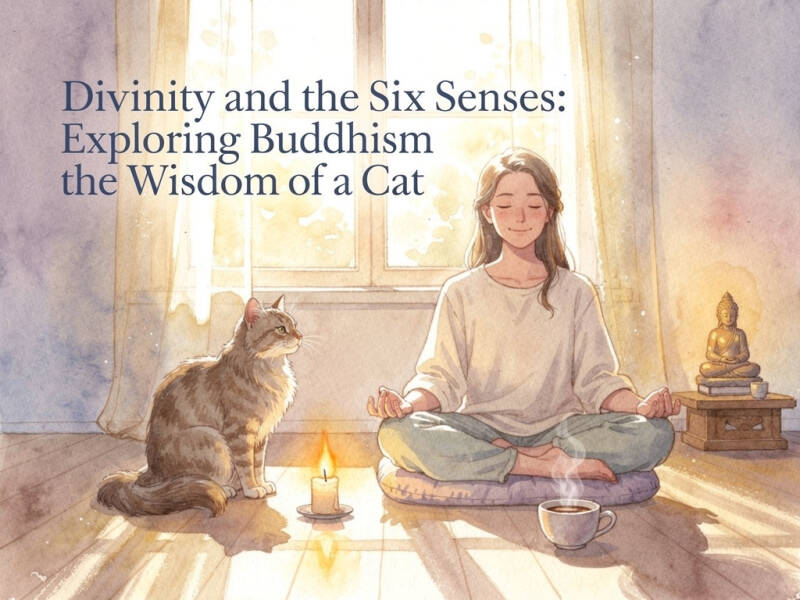
There are evenings when silence settles like a gentle touch, when every breath becomes a prayer. In these moments, a cat—eyes half-closed—seems to listen to the universe. She doesn’t meditate as we do, but her simple purr is an invitation to slow down, to feel life pulsing within us. Buddhism, too, speaks of presence, awareness, and liberation. Yet it doesn’t ask us to believe in a creator god, but to discover the divine within and around us, through our senses and our attention.
In this article, we’ll explore how Buddhism’s notions of god and divinity resonate with a cat’s six senses—those open doors to the world, bridges between the tangible and the invisible. Together, we’ll journey through sight, hearing, smell, taste, touch, and that sixth sense that connects us to what truly matters. Prepare to see your daily life in a new light, through the eyes of a feline and the ancient wisdom of the Buddha.
God and Divinity in Buddhism: A Spirituality Without Dogma
No Creator God, but an Inner Divinity
Buddhism doesn’t speak of an all-powerful god who judges or rewards. Instead, it speaks of the Buddha nature within each of us: that spark of wisdom and compassion we carry, often buried beneath layers of ego and illusion. Buddhist deities, like bodhisattvas, are not supreme beings to worship but guides, mirrors of what we can become. They remind us that divinity isn’t "out there" but here, in every mindful moment.
Imagine a cat settling beside you, peaceful and present. She doesn’t seek adoration; she simply is. She embodies this truth: spirituality isn’t a distant quest but a daily practice, accessible to all.
The Gods of Buddhism: Beings of Light in Evolution
In Buddhist texts, devas (gods) live in realms of bliss, yet they are not free from the cycle of rebirth (samsara). Their existence, however radiant, is impermanent. Their role? To inspire us to cultivate wisdom and compassion, so we, too, can transcend suffering.
A cat, with her grace and serenity, is a four-legged deva. Without words, she shows us how to live in the moment, free from attachment or fear.
A Cat’s Six Senses: A Living Meditation
1. Sight: Seeing Beyond Appearances
Watch a cat observe the world. Her eyes—sometimes half-closed, sometimes wide—capture every detail with judgment-free curiosity. In Buddhism, sight is linked to clairvoyance: the ability to perceive reality as it is, unfiltered. When a cat gazes at a sunbeam or follows a falling leaf, she teaches us to marvel at the ordinary.
Your turn:
Sit by a window. Notice how the light shifts, how shadows dance. Let your gaze rest on the details without analyzing. Just see. You’ll discover hidden beauty in the everyday.
2. Hearing: Listening to Silence
A cat’s purr is a sacred melody. It invites us to truly listen—to the wind, our breath, the silence between words. In Buddhism, hearing is the sense of receiving teachings. Listening opens us to wisdom, whether through a sacred text, birdsong, or a loved one’s breath.
Your turn:
Close your eyes. Focus on the sounds around you. Let them flow in and out like waves. This simple act is meditation, a way to connect with the present.
3. Smell: Breathing in Presence
A cat sniffs every novelty with intensity, as if each scent is a doorway to an unseen world. In Buddhism, smell is tied to purity: the ability to discern what nourishes the soul from what pollutes it. Nasal breathing—a practice you hold dear—grounds us in the body and cleanses the mind.
Your turn:
Breathe deeply, as a cat explores a new space. Feel the air entering and leaving, fresh and alive. Imagine each inhale cleansing your mind, each exhale releasing tension.
4. Taste: Savor Impermanence
A cat savors each bite as if it’s the first and last. Buddhism teaches that everything is impermanent—even the most delicious flavors. Taste reminds us to enjoy life without clinging, to relish each experience with gratitude.
Your turn:
Take a sip of your favorite drink or a piece of chocolate. Let the flavor unfold, then fade. Observe how the experience changes, moment by moment.
5. Touch: Sacred Connection
When a cat curls up against you, her soft, warm fur is a lesson in mindful contact. In Buddhism, touch is a gateway to compassion. Every caress, every embrace, is an opportunity to connect—with ourselves, others, and the world.
Your turn:
Place a hand on your heart. Feel its rhythm. Then, touch something near you—a fabric, a plant, a cat’s fur. Be fully present with the sensation.
6. The Sixth Sense: Intuition, Pure Presence
A cat senses things before they happen. She perceives emotions and energies as an extension of her other senses. In Buddhism, this sixth sense is direct knowing—the intuitive wisdom that arises when the mind is still.
Your turn:
Sit quietly with a cat (or alone). Close your eyes. Notice what arises—a feeling, an image, a certainty. Don’t analyze; just feel.
Sophrology and Cats: A Dance of Awareness
Sophrology and meditation bridge body and mind. A cat, with her six senses, is a master of this art. She shows us how to breathe, relax, and simply be.
When you meditate in the evening, with a cat beside you, you create a sacred space. Your synchronized breath—hers rhythmic and soothing, yours deep and conscious—becomes a shared meditation. It’s a dance between Shiva (energy) and Buddha (awareness), a union of movement and stillness.
Your turn:
Lie down near a cat (or imagine one). Sync your breath with hers. Inhale as she inhales, exhale as she exhales. Let this natural rhythm carry you. You’ll find it’s a wordless prayer.
Conclusion: Divinity in the Moment
Buddhism and cats offer the same lesson: divinity isn’t a distant concept but a living experience. It’s in the sunbeam warming the floor, the purr that lulls you to sleep, the breath that anchors you to now.
Next time a cat settles beside you, remember: she’s more than a pet. She’s a teacher, a deva, a companion on the path to awakening. And you? You’re already on that path. Every sense you cultivate, every moment of presence, is a step toward liberation.
Question for you:
Which sense speaks to you most today? How can you use it to deepen your connection to the present?
Ajouter un commentaire
Commentaires