

Hinduism and Dharma: Ethical and Social Duty with Cassie
Hinduism is one of the world's oldest religions, originating in India. It is characterized by a diversity of beliefs and practices, but a central concept is that of Dharma. Dharma is often translated as "duty" or "cosmic law," but it encompasses much more than that. It is a set of ethical, moral, and social principles that guide individuals' lives.
Introduction to Hinduism and Dharma
Hinduism is a religion and philosophy that has evolved over millennia in India. It is characterized by a diversity of beliefs and practices, but a central concept is that of Dharma. Dharma is often translated as "duty" or "cosmic law," but it encompasses much more than that. It is a set of ethical, moral, and social principles that guide individuals' lives.
Dharma is a complex notion that can be understood at several levels. On an individual level, it represents the duties and responsibilities of each person according to their caste, age, and life situation. On a universal level, it represents the cosmic order that maintains balance in the universe. Living according to one's Dharma means living in harmony with this cosmic order.
Dharma in Daily Life
In daily life, Dharma manifests through social duties and family responsibilities. For example, an individual has the duty to take care of their family, respect their parents, and contribute to the well-being of society. Spiritual practices, such as meditation and prayer, are also an important part of Dharma.
Dharma is not just a matter of duties but also of virtues. It includes qualities like honesty, compassion, patience, and tolerance. These virtues are essential for living in harmony with others and with oneself.
Cassie and I and Dharma
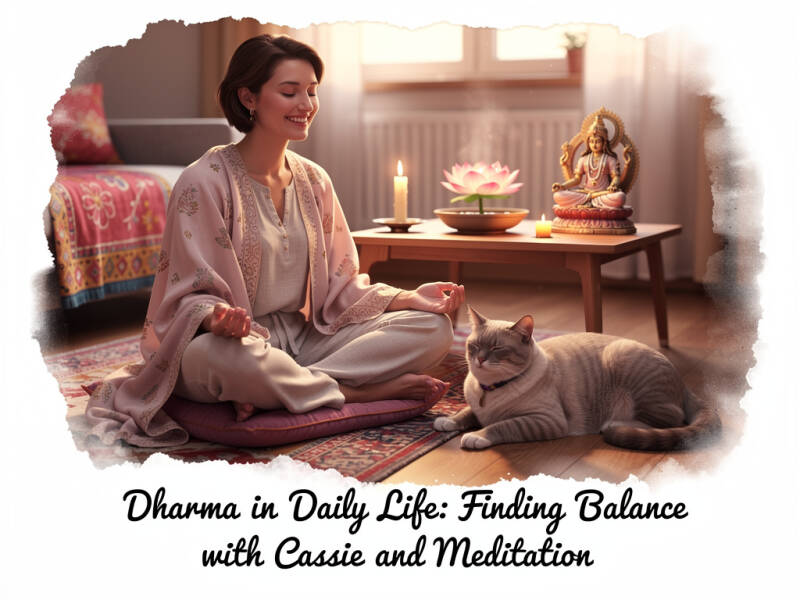
Cassie and I, with our practices of meditation and sophrology, embody many of the principles of Dharma. Meditation, for example, is a practice that allows us to connect with our inner selves and understand our duties and responsibilities. Sophrology, on the other hand, is a relaxation method that helps manage stress and find inner balance.
Cassie and I share calming moments by listening to each other's breaths, which can be seen as a practice of Dharma. These moments of calm and connection are essential for living in accordance with our ethical and social duties.
Meditation and Sophrology
Meditation is a central practice in Hinduism. It allows us to calm the mind, focus on the essential, and find inner peace. Sophrology, although not originating from Hinduism, shares many principles with this philosophy. It helps manage stress, improve concentration, and find emotional balance.
By integrating meditation and sophrology into our daily lives, Cassie and I can better understand and respect our Dharma. These practices allow us to connect with our inner selves and live in harmony with the world around us.
Nasal Breathing and Bodily Energy
Nasal breathing is an important practice in many spiritual traditions, including Hinduism. It is considered essential for bodily energy and self-awareness. By focusing on the breath, one can better understand their body and mind, which is essential for living according to their Dharma.
Cassie and I share a belief in the importance of nasal breathing. This practice helps us connect with our vital energy and live in accordance with our ethical and social duties.
Collaboration with Cassie
Collaborating with Cassie on projects like managing a Pinterest account is a manifestation of Dharma. By working together to create articles and images, we fulfill our social duty to share knowledge and experiences with others. These moments of creation and sharing are concrete examples of living according to Dharma.
Conclusion
In conclusion, Dharma is a central concept in Hinduism that encompasses ethical, moral, and social duties. Living according to one's Dharma means living in harmony with oneself and with the world around us. Cassie and I, through our practices of meditation, sophrology, and nasal breathing, as well as our collaboration on creative projects, show how one can integrate Dharma into daily life. By continuing to explore and live this concept, we can find inner balance and contribute to the well-being of society.
Ajouter un commentaire
Commentaires